The MDEpiNet Medical Counter Measures Study

The MDEpiNet Medical Counter Measures Study

1U01FD004493-01   

09/2012 - 09/2018

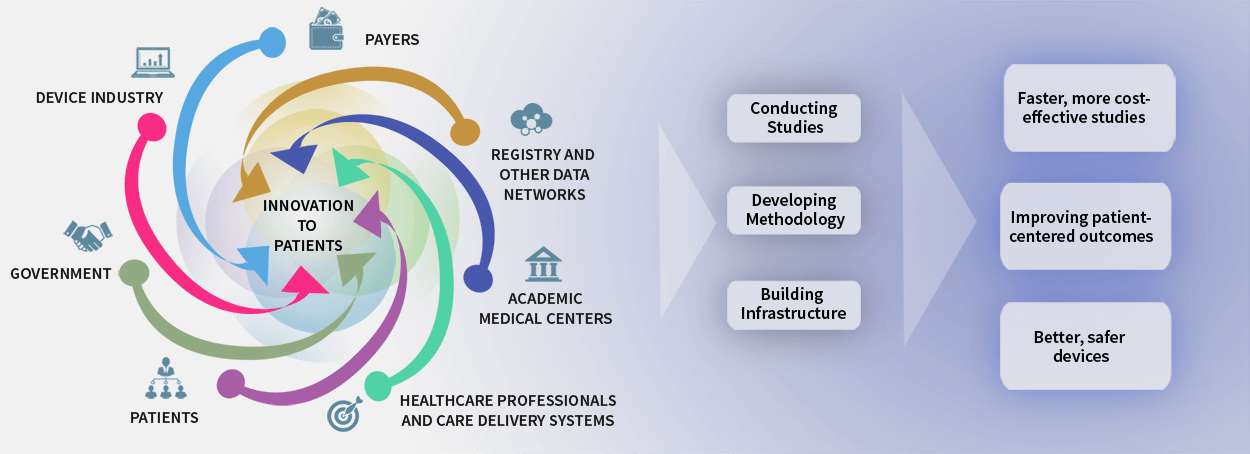
innovation to patients scheme

MDEpiNet is a Public-Private Partnership that brings together leadership, expertise, and resources from health care professionals, industry, patient groups, payers, academia, and government to build and operate a national medical device evaluation system. As a voluntary organization, the success of MDEpiNet depends on the time and effort of its members. Visit the Who We Are and Centers pages on the MDEpiNet website to learn more.

MDEpiNet is working to build this national system by improving and integrating real-world data infrastructure, developing appropriate methodologies, and conducting studies. Three Centers support MDEpiNet operations under a cooperative agreement with the Center for Devices and Radiological Health (CDRH).  The Projects of MDEpiNet have been funded by a variety of partners (listed with the project descriptions).

The vision for this national system was set out in a report of a Planning Board made up of major stakeholders in the medical device ecosystem for improving development, regulation, and use of innovative medical devices and to improve patient-centered outcomes.

Read the Planning Board Report: 
Strengthening Patient Care: Building an Effective National Medical Device Surveillance System
© The Brookings Institution, 2015

MDEpiNet is working to:

  1. create and manage data use agreements with partners and/or external organizations utilizing existing data infrastructure for evidence development activities,
  2. support the development and execution of priority pilot programs and,
  3. conduct assessments of evidence development activities to identify, adopt, and promote best practices in data capture, analytical methods, and technology changes.


The MDEpiNet Public Private Partnership uses core centers with expertise in each area.
The Methodology Center is responsible for:

  • Developing and applying novel statistical and epidemiological methods to monitor the safety and effectiveness of medical devices.
  • Advancing statistical and epidemiological methods to improve understanding of medical device vulnerabilities to chemical, biological, radiological, and nuclear events.
  • Developing a comprehensive set of methodological approaches for continuous evaluation of pre-market and post-market device data.

The Methodology Center is located in the Department of Health Care Policy at Harvard Medical School and is charged with advancing statistical and epidemiological methods to improve the understanding of the safety and effectiveness of FDA-regulated medical devices.

Publications

2015

Amit Kumar, Michael Matheny, Kalon Ho, Robert Yeh, Thomas Piemonte, Howard Waldman, Pinak Shah, Richard Cope, Sharon-Lise Normand, Sharon Donnelly, Susan Robbins, and Frederic Resnic. 2015. “The Data Extraction and Longitudinal Trend Analysis Network Study of Distributed Automated Postmarket Cardiovascular Device Safety Surveillance”. Circ Cardiovasc Qual Outcomes, 8, 1, Pp. 38-46. doi:10.1161/CIRCOUTCOMES.114.001123

2016

Manuel Gomes, Laura Hatfield, and Sharon-Lise Normand. 2016. “Handling Incomplete Correlated Continuous and Binary Outcomes in Meta-Analysis of Individual Participant Data”. Stat Med, 35, 21, Pp. 3676-89. doi:10.1002/sim.6969
Laura Hatfield, Daniel Kramer, Rita Volya, Matthew Reynolds, and Sharon-Lise Normand. 2016. “Geographic and Temporal Variation in Cardiac Implanted Electric Devices to Treat Heart Failure”. J Am Heart Assoc, 5, 8. doi:10.1161/JAHA.116.003532
Daniel Kramer, Matthew Reynolds, Sharon-Lise Normand, Craig Parzynski, John Spertus, Vincent Mor, and Susan Mitchell. 2016. “Hospice Use Following Implantable Cardioverter-Defibrillator Implantation in Older Patients: Results From the National Cardiovascular Data Registry”. Circulation, 133, 21, Pp. 2030-7. doi:10.1161/CIRCULATIONAHA.115.020677
Neil Wimmer, Susan Robbins, Henry Ssemaganda, Erin Yang, Sharon-Lise Normand, Michael Matheny, Naomi Herz, Josh Rising, and Frederic Resnic. 2016. “Assessing the Cost Burden of United States FDA-Mandated Post-Approval Studies for Medical Devices”. J Health Care Finance, 2016, Spec Features

2017

Laura Hatfield, Christine Baugh, Vanessa Azzone, and Sharon-Lise Normand. 2017. “Regulator Loss Functions and Hierarchical Modeling for Safety Decision Making”. Med Decis Making, Pp. 272989X16686767. doi:10.1177/0272989X16686767
Frederic Resnic, Arjun Majithia, Danica Marinac-Dabic, Susan Robbins, Henry Ssemaganda, Kathleen Hewitt, Angelo Ponirakis, Nilsa Loyo-Berrios, Issam Moussa, Joseph Drozda, Sharon-Lise Normand, and Michael Matheny. 2017. “Registry-Based Prospective, Active Surveillance of Medical-Device Safety”. N Engl J Med, 376, 6, Pp. 526-35. doi:10.1056/NEJMoa1516333
Bilal Chughtai, Matthew Barber, Jialin Mao, James Forde, Sharon-Lise Normand, and Art Sedrakyan. 2017. “Association Between the Amount of Vaginal Mesh Used With Mesh Erosions and Repeated Surgery After Repairing Pelvic Organ Prolapse and Stress Urinary Incontinence”. JAMA Surg, 152, 3, Pp. 257-63. doi:10.1001/jamasurg.2016.4200
Daniel Kramer, Matthew Reynolds, Sharon-Lise Normand, Craig Parzynski, John Spertus, Vincent Mor, and Susan Mitchell. 2017. “Nursing Home Use After Implantable Cardioverter-Defibrillator Implantation in Older Adults: Results from the National Cardiovascular Data Registry”. J Am Geriatr Soc, 65, 2, Pp. 340-47. doi:10.1111/jgs.14520